Early warning signs from reproductive life history
Published in Proceedings of the Royal Society B as Kahanamoku et al. (2025)
The Santa Barbara Basin is a system poised on the edge of viability, an extreme environment where life history trade-offs are recorded in the fossil record in close to real-time.
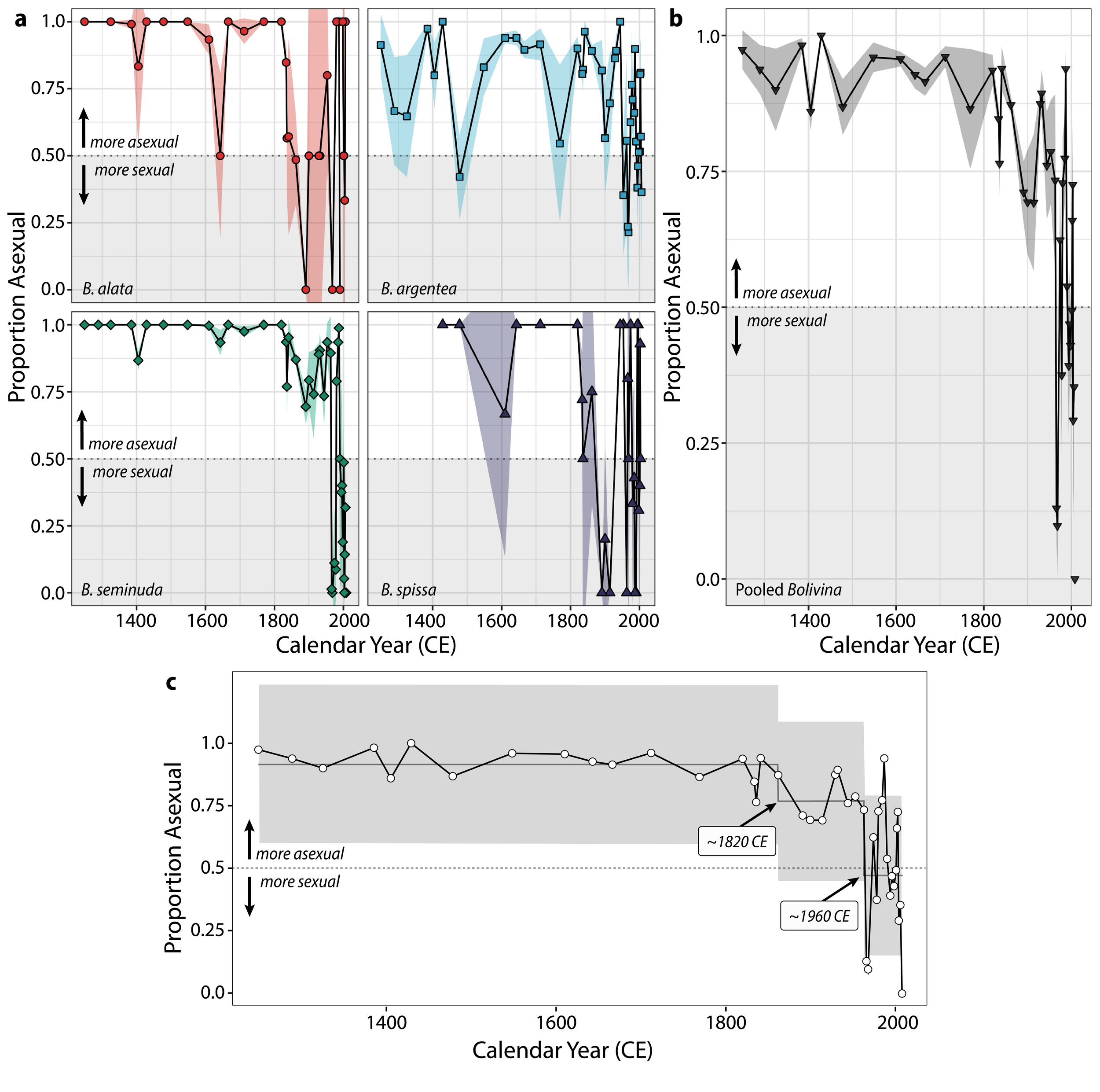
We take advantage of this system to test life history theory on reproductive trade-offs expected over long timescales and under environmental change. Using a dataset of morphological characteristics from more than 20,000 Bolivina benthic foraminifera from four species (Kahanamoku et al. 2024), we find that asexual reproduction is favored over long timescales by Bolivina, with high-output asexual blooming events being the most common mode of reproduction for much of the Common Era.
We also uncover a previously unrecognized change in Bolivina reproductive life history that occurs in the late-19th through mid-20th century CE, with this novel state persisting through the present day. This reproductive shift is neither explained by common oceanographic factors nor by impacts to the California Current System under anthropogenic climate change. Rather, the timing of change suggests that novel land-use regimes introduced in the 19th century, and expanded in the 20th century, may have altered reproductive dynamics in benthic foraminifera in this region.